Jane discovers Anna photographing her
The Woman in the WindowJane discovers Anna photographing her when Anna watches the Russells through a camera from her study. The encounter breaks the one-way privacy Anna has constructed behind her windows: Jane looks back, waves, and makes Anna feel exposed. Anna’s flight and shame reveal how surveillance has become both a retreat from the outside world and a means of approaching a family that resembles the one she has lost.
The Watcher at the Window
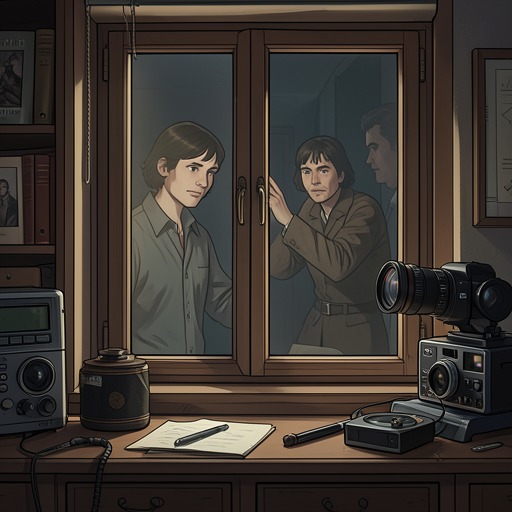
Anna settles into the corner of her study with a tumbler in one hand and her Nikon D5500 camera in the other, surveying the neighborhood as an inventory. Her attention moves across people and houses, turning ordinary passing scenes into material for observation. She adjusts the lens to inspect a woman returning from yoga and silently invents possible conversations for strangers. The invention gives way to self-awareness: Anna recognizes that she is making up dialogue about people she cannot hear.
The Russells command a different kind of attention. Anna moves her view cautiously across the park to their house, where she finds the kitchen dim and empty and the blinds partly lowered. Upstairs, Jane Russell and Ethan Russell sit together on a candy-striped love seat. Through the lens, Anna sees Jane speaking quickly, smiling with her teeth visible and gesturing with her hands, while Ethan looks down with a shy smile. Jane wears a yellow sweater and a locket depicting a mountaineer above a gorge. The camera brings these details close, but it does not give Anna access to what the two are saying.
Recognition Across the Park
Anna has not told Dr. Julian Fielding about watching the Russells. She understands the attraction through her own self-analysis: the household of a mother, a father, and their only child resembles her former family. Their home across the park seems to hold, in miniature, the life Anna believes she has lost. This recognition helps explain why she singles out the Russells from the neighborhood she has watched for months; it does not make her observation less intrusive.
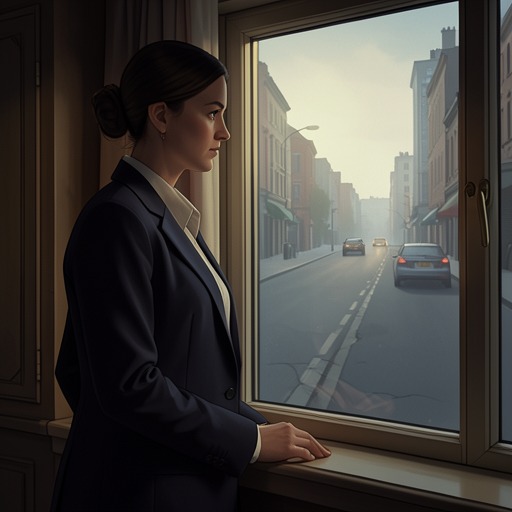
As Anna raises the camera again, Jane is looking straight back at her. Anna lowers the camera into her lap, but the distance and the lens no longer protect her from recognition. She can see Jane’s steady gaze and parted lips even without the camera. Jane raises a hand and waves. The gesture makes the exchange unmistakably reciprocal: Anna has been looking at Jane, and Jane has noticed Anna looking. What Anna had treated as private observation has become a visible act.
Flight and Shame
Anna considers whether to wave back, look away, or pretend that the camera had been aimed somewhere else. Instead, she jumps to her feet, lets the camera tumble to the floor, and runs into the dark stairwell. Her abrupt escape is the immediate consequence of being seen. The instrument that had enabled her to observe from indoors is left behind at the moment the person she watches acknowledges her presence.
The scene also interrupts Anna’s sense that she has remained unnoticed. She recalls having photographed neighbors, strangers, and the postman, returning to those images for months until she could no longer keep pace with the world beyond her window. Her hard drive is swollen with stolen pictures. The archive contains not just people passing by but private fragments of their lives: a child with closed eyes and trembling fingers on cello strings, neighbors raising wineglasses, a woman lighting birthday candles, and a couple arguing in a room with a shattered vase between them. These memories make the discovery more than an awkward encounter with Jane; they force Anna to reckon with the accumulated reach of her looking.
Anna’s reaction shifts from the fear of being caught to shame at what the camera has collected. She recognizes that she is neither invisible nor outside the scene: she is alive, exposed, and subject to another person’s gaze. The reversal is sharpened by her own attention to Jane across the park. Jane’s look does not reveal what she thinks, but her wave establishes that Anna can no longer imagine herself as an unseen observer.
From Exposure to Contact
The next encounter at Anna’s door gives the discovery a different consequence. The woman who visits teases Anna about being bored, folds her into a hug, and brings a cold bottle of Riesling. Anna laughs nervously and remains silent as the visitor comes inside. The welcome does not erase the watching or Anna’s shame, but it changes the relation between the women: the person first encountered through a distant camera is now physically present in Anna’s home, initiating contact and offering company.
The episode’s force comes from that movement between distance and proximity. Anna begins with the camera as a tool for inventorying a world she can no longer readily enter; the lens offers detail while preserving separation. Jane’s gaze collapses that arrangement, and Anna responds by fleeing. Yet the later visit makes the encounter more than exposure alone. Looking across the park has made a connection possible, though it begins on terms Anna did not control and leaves her visibly nervous. The scene therefore marks both the intrusion inherent in Anna’s surveillance and the fragile possibility of contact beyond it.